
Bold.org: Scholarships
Bold.org, Inc.Education
4.6667.00 Reviews
- Version
- 0.78.0
- Installs
- 50.00K
- Age Rating
- Everyone
Screenshots

Our Review of Bold.org: Scholarships
 Analysis by Appyee
Finding financial help for education can feel like a second job. Scholarship searches are often scattered across many websites, each with different eligibility rules, deadlines, application forms, and writing requirements. Bold.org: Scholarships approaches that problem as a free education app from Bold.org, Inc., focused on grants, rewards, and student aid. I found its main appeal in putting scholarship discovery into a more convenient mobile setting rather than treating it like a one-time search.
That convenience matters, but it does not turn scholarship applications into effortless money. The useful question is whether the app helps you build a more consistent search habit and identify opportunities worth your time. In my view, it can be a practical companion for students who are willing to read the details carefully and apply selectively. It is less suitable for anyone expecting guaranteed funding, instant results, or a replacement for a complete financial-aid plan.
How Bold.org: Scholarships fits into a student’s search
The app belongs in the education category, although its everyday purpose is more practical than academic. Instead of teaching a school subject, it helps students look for financial opportunities connected with education. The store summary presents it around grants, rewards, and student aid, while the short description identifies Bold.org. That makes the app easiest to understand as a discovery and application aid rather than a budgeting tool, loan calculator, or full admissions platform.
When I use an app like this, I do not judge it only by how many listings appear on the screen. The real test is whether I can move from browsing to a sensible shortlist without wasting time on opportunities that clearly do not fit. A scholarship search becomes valuable when it helps answer practical questions: Am I eligible? Is the deadline realistic? What materials are needed? Does this opportunity match my background, course, goals, or circumstances?
Bold.org: Scholarships has attracted a 4.6 average from around eight hundred ratings, with roughly seven hundred written reviews. That level of public response suggests that many users find the concept useful enough to rate, but ratings should still be read with the right expectations. A strong score can reflect an easy browsing experience, while the personal outcome of a scholarship search depends heavily on eligibility and application quality.
The app has reached over fifty thousand installs, which gives it a meaningful presence among student-focused tools without making it something every student automatically needs. It is free to install and use in the sense relevant to this review: there is no purchase price presented for access. That is important because scholarship-search tools are most useful when they remove a financial barrier rather than adding another one.
What “free” means in practical use
The free price makes it reasonable to try, but I would not confuse free access with free results. Your time, attention, writing effort, and document preparation still have a cost. A student can lose an evening applying for an opportunity that was never a good match, especially when an appealing title hides a narrow eligibility requirement.
My approach is to treat the app as a filter, not as an automatic funding source. I would browse when I have enough time to read the complete requirements, save only realistic possibilities, and keep a separate note with deadlines and application status. That small workflow prevents the common mistake of opening many opportunities and finishing none.
The app is marked for Everyone, making its age classification broad and approachable for general users. In practice, the people who will gain the most are students, prospective students, and families helping with education planning. The age label should not be treated as proof that every scholarship suits every applicant; eligibility still needs to be checked opportunity by opportunity.
The value of a centralized scholarship routine
The strongest value is organizational. Searching through one dedicated app can be easier than relying on random web searches, social posts, school emails, and word of mouth. Those sources can still be helpful, but they tend to produce an uneven stream of information. A focused app gives the search a regular place in your routine.
I found the idea particularly useful for students who are early in the process and do not yet know what kinds of scholarships exist. A student may begin with a broad goal such as reducing tuition pressure, then gradually learn to look for opportunities connected with personal circumstances, academic direction, activities, or community involvement. That shift from vague browsing to targeted searching is where the app can become more valuable.
Another benefit is psychological rather than technical. Scholarship research can feel discouraging when every search produces a large number of unrelated results. A mobile app makes it easier to check briefly and return later, which can turn the process into a repeated habit instead of a stressful weekend project. I would rather spend a few focused minutes several times than attempt a giant search once and abandon it.
There is also value in comparing opportunities before committing. A student can consider the effort required, the fit with their experience, and the deadline pressure. That comparison is more useful than applying indiscriminately. A short application with a strong personal connection may deserve priority over a longer application that only technically accepts the student.
A realistic everyday scenario
Imagine a student preparing for the next academic term while working part-time. They have a short break during a commute or between classes, but not enough time to write a complete application. Using Bold.org: Scholarships during that break, they can browse possibilities, note the ones that appear relevant, and return later with a clearer plan. In the evening, they can review the requirements and decide whether one application is worth completing.
The important part of that scenario is not the browsing itself. It is the separation between discovery and commitment. I would avoid writing an essay immediately after seeing an attractive title. First, I would verify the eligibility language, deadline, requested materials, and whether my own experience gives me something specific to say. This two-step process reduces wasted effort and produces more thoughtful applications.
For a parent or counselor, the app may also serve as a conversation starter. Instead of simply telling a student to “look for scholarships,” they can review a few possibilities together and discuss fit, workload, and timing. That does not replace official school financial-aid guidance, but it can make the search feel more concrete.
Where it differs from usual alternatives
The usual alternative is a general web search. The web offers a wider universe of sources, but it also requires more judgment about relevance, freshness, and trust. Bold.org: Scholarships is more focused, which can make the first stage of discovery less exhausting. On the other hand, relying on one app alone could narrow your search if a school, local organization, employer, or community group offers opportunities elsewhere.
Another alternative is asking a school counselor or financial-aid office. That route is often better for institution-specific guidance, application strategy, and questions about how outside aid may interact with a student’s situation. The app is more convenient for independent browsing, while a counselor can provide context that a listing alone cannot. I see them as complementary rather than interchangeable.
Search engines and spreadsheets can also be useful. A spreadsheet gives excellent control over deadlines, documents, essay topics, and submission status, but it does not provide discovery by itself. The app can help generate possibilities, while a personal tracking system can manage the work afterward. For serious applicants, using both is more effective than expecting the app to handle the entire process.
Tradeoffs that affect the real value
The first tradeoff is volume versus attention. More opportunities can look encouraging, but every application has an opportunity cost. Students should resist the urge to measure progress by the number of listings viewed. A better measure is how many suitable opportunities have been researched carefully and how many strong applications are actually submitted.
The second tradeoff is convenience versus verification. A dedicated scholarship app makes discovery easier, but the applicant remains responsible for reading the full rules and preparing accurate information. I would never assume that a promising title means an opportunity is suitable. Details about education level, location, field, personal background, deadlines, and required materials can change the decision completely.
The third tradeoff is mobile access versus writing comfort. A phone is excellent for browsing and quick notes, but long personal statements are usually easier to draft on a larger screen. My preferred workflow would be to use the app for discovery and early organization, then write and proofread substantial responses elsewhere if needed. That keeps the phone from becoming a cramped writing desk.
There is also a motivation risk. Because the app is free and easy to open, it can encourage casual browsing without follow-through. I would set a small, specific goal before opening it: identify a few plausible opportunities, inspect their requirements, or return to one application already in progress. Without a goal, scholarship browsing can become another form of procrastination.
Tips for getting more from the search
My first tip is to create a personal eligibility checklist before browsing. Include your education stage, intended area of study, location, relevant activities, and any personal characteristics that commonly affect eligibility. This lets you reject poor matches quickly instead of emotionally investing in every appealing listing.
Second, separate “interesting” from “actionable.” An opportunity may sound ideal but require an essay, recommendation, portfolio, or document that you cannot prepare before the deadline. Mark it as a later possibility if appropriate, but prioritize options where you can submit a complete and careful application.
Third, reuse ideas without submitting recycled writing. Your experiences, goals, and examples can form a personal bank of material, but each response should answer the actual prompt. A generic essay may save time initially and weaken the application later. I would keep notes on specific moments, responsibilities, challenges, and future plans, then adapt them honestly.
Fourth, maintain a simple record outside the app. Note the opportunity, deadline, requirements, date started, and date submitted. This is especially useful when several applications ask for similar information. It also prevents the frustrating situation of forgetting whether an application was completed or merely viewed.
Finally, compare the effort with the likely usefulness of the opportunity without assuming an outcome. Since the app is free, the main investment is your time. That makes selectivity even more important: free access is a reason to explore, not a reason to apply to everything.
Who should use it and who should skip it
I would recommend trying it to students who want a dedicated place to begin or maintain a scholarship search, especially those who feel overwhelmed by scattered information. It can also suit families supporting a student, adult learners returning to education, and applicants who prefer checking opportunities from a phone rather than beginning with a desktop browser.
It is a weaker fit for someone who already has a well-managed scholarship pipeline through a school counselor, local organizations, professional groups, and a carefully maintained spreadsheet. That person may still find additional opportunities, but the app may add another source to monitor without solving a real problem.
I would also advise caution for students who need immediate, guaranteed financial assistance. Scholarship searching is uncertain and competitive by nature. If tuition decisions are urgent, the app should sit alongside direct conversations with a school’s financial-aid office, not replace them. Students who dislike reading eligibility rules or tracking deadlines may also find the process frustrating, regardless of how convenient the app feels.
Device details and overall usability context
The current version is 0.78.0, and the listed minimum operating-system requirement is Android 7.0. That makes it accessible to many older Android devices, which is useful for students who do not have a recent phone. Still, compatibility alone does not guarantee that every device will feel equally comfortable for extended writing or document handling.
I would use the app as part of a broader system: browse on the phone, record decisions in a checklist, prepare polished materials in the tool that feels most comfortable, and confirm every submission before the deadline. This division of labor is more realistic than expecting a scholarship app to replace personal organization, school support, and careful application writing.
My final recommendation
Bold.org: Scholarships delivers its clearest value through free access to a focused scholarship-search experience. I like it most as a starting point and a habit-building tool: something I can open regularly, identify realistic opportunities, and turn scattered research into a manageable plan. Its 4.6 average and growing install base make it worth considering, but they do not change the need for careful eligibility checks or strong applications.
My verdict is to try it if you are actively looking for education funding and are prepared to invest time rather than expecting automatic results. Keep your school’s financial-aid resources, local opportunities, and a personal deadline tracker in the mix. The best use of Bold.org: Scholarships is not endless browsing; it is disciplined discovery followed by selective, well-prepared applications.
Verdict
Strengths of Bold.org: Scholarships
- Free to browse and apply for many scholarship opportunities.
- Personalized matches help surface awards suited to your profile.
- New scholarship listings are added regularly.
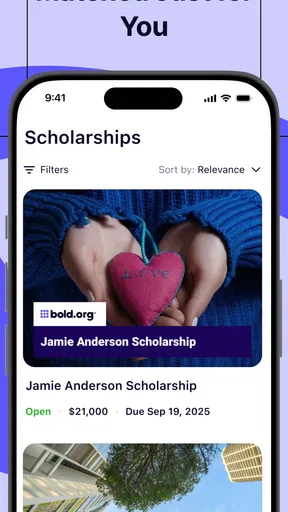
- Application details and deadlines are clearly displayed.
- Available on mobile, making scholarship searches convenient anywhere.
Limitations of Bold.org: Scholarships
- Some scholarships require lengthy essays or detailed application forms.
- Eligibility rules vary widely and can take time to review.
- Competition may be high for popular scholarship awards.
- Not every listing guarantees funding or a response from sponsors.
- You may receive notifications or promotional emails after signing up.
Similar Picks in This Category
View All
Duolingo: Language Lessons
Duolingo4.7

Google Classroom
Google LLC2.8

Unacademy: Learn & Crack Exams
Unacademy3.2

Bible App for Kids
Life.Church4.4

Cake - Learn English & Korean
Cake Corp.4.7

Brainly: AI Homework Helper
Brainly4.5
Frequently Asked Questions
What is Bold.org: Scholarships and how does it work?
Bold.org is a scholarship search and application platform designed to help students discover financial aid opportunities. After creating a profile, you can browse scholarships using filters such as education level, location, field of study, and eligibility requirements. Each listing explains the award, deadline, requirements, and application process, although some opportunities may require additional essays or personal information.
Is Bold.org: Scholarships free to download and use?
Yes, students can generally download and use the Bold.org app without paying a subscription fee. Creating a profile, searching for scholarships, and submitting applications are typically free. However, you should always review each scholarship’s terms carefully and avoid offers that request payment to apply. Legitimate scholarship applications should not require you to pay an entry fee or purchase a product.
Who can apply for scholarships through Bold.org?
Eligibility depends on the individual scholarship rather than the app itself. Opportunities may be available to high school students, college students, graduate students, parents, or people returning to education. Requirements can include academic level, age, residency, career goals, financial circumstances, or a specific field of study. Read every listing carefully before spending time preparing an application.
What information is required to create a Bold.org profile?
The app may ask for basic personal, academic, and contact information so it can recommend relevant scholarships. Depending on your profile and the application, you may also provide your school details, graduation date, interests, achievements, or an essay. Because this information can be sensitive, check the platform’s privacy policy and only submit details that are necessary for a legitimate scholarship application.
Can Bold.org guarantee that I will receive a scholarship?
No. Bold.org can help you find and apply for scholarship opportunities, but it cannot guarantee an award. Scholarships are competitive, and decisions are made by the organizations or sponsors offering the funds. Your chances may improve by completing your profile accurately, applying before deadlines, following instructions closely, and submitting thoughtful, original responses tailored to each scholarship.
